





Family Law
How legal aid supports family law cases in UK 2026

Many people facing separation believe legal aid is unavailable or too difficult to access. This misconception prevents vulnerable families from getting vital support during divorce, child arrangements disputes, or domestic abuse situations. Legal aid remains available for specific family law cases in the UK, particularly those involving child welfare or abuse. Understanding eligibility, evidence requirements, and application steps can secure essential representation when you need it most.
Table of Contents
- Understanding Legal Aid In Family Law Cases
- Eligibility Criteria: Means And Merits Tests Explained
- Using Evidence To Strengthen Your Legal Aid Application
- Challenges Facing Family Legal Aid And Its Impact On Access To Justice
- How To Access Legal Aid For Family Law Cases In The Uk
- Get Expert Family Law Support With Legal Aid
Key takeaways
| Point | Details |
|---|---|
| Case coverage | Legal aid supports family law cases involving child welfare, domestic abuse, and child arrangements in England and Wales. |
| Dual testing | Applicants must pass both means and merits tests, assessing finances and case strength. |
| Evidence matters | Documentation of domestic abuse or child risk significantly strengthens applications and speeds approval. |
| Funding pressure | Fee cuts over 30 years have reduced legal aid availability and quality, affecting access to justice. |
| Early action | Accessing legal advice quickly through legal aid ensures timely protection orders and case resolution. |
Understanding legal aid in family law cases
Legal aid provides government funding for legal advice and representation in specific circumstances. It does not always cover every stage of proceedings, particularly contested final hearings, but offers crucial support during early stages and emergencies. Legal aid is available for family law cases in England and Wales, with distinct eligibility rules.
The scheme primarily covers:
- Child arrangement orders and contact disputes
- Domestic abuse protection applications
- Divorces involving children or abuse
- Applications to restrict or remove parental responsibility
- Emergency protection orders
Legal aid can fund applications to prevent an abusive partner from having child contact or to secure urgent protective measures. This targeted support focuses resources where vulnerability and risk are highest. For individuals navigating different types of family law cases, understanding which situations qualify helps clarify whether assistance is accessible.
The scheme recognises that family disputes often involve power imbalances, especially in abuse situations. By prioritising child welfare and survivor safety, legal aid serves its core purpose of protecting those who cannot afford private representation during critical legal battles.
Eligibility criteria: means and merits tests explained
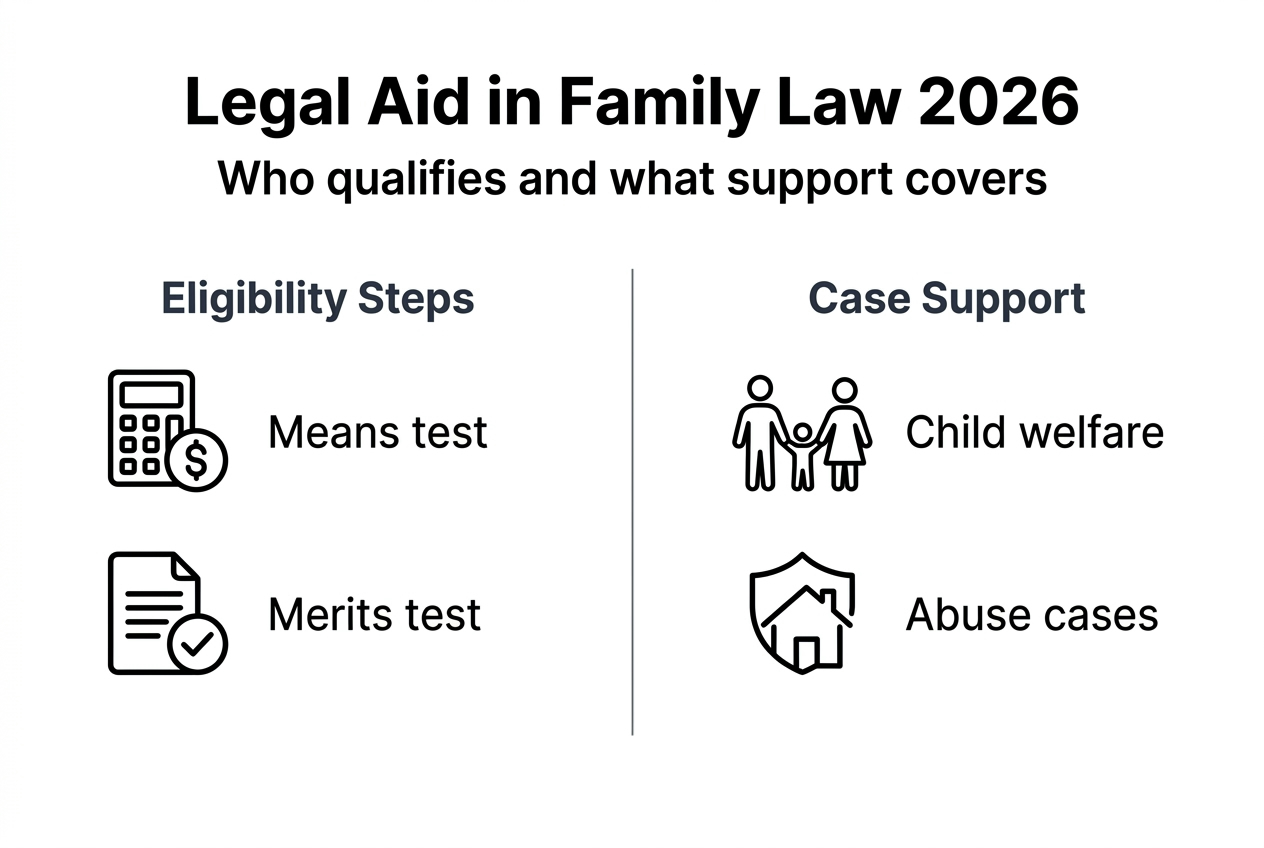
Qualifying for legal aid requires satisfying two distinct assessments. The means and merits tests work together to determine whether your financial situation and legal case warrant public funding. Neither test alone is sufficient.
The means test examines your complete financial picture:
- Monthly income from all sources, including benefits and employment
- Savings, investments, and property equity
- Partner’s finances if you live together
- Number of dependent children and their ages
- Essential outgoings like housing costs and childcare
You must provide bank statements, payslips, benefit letters, and property valuations. The assessment considers disposable income and capital after deducting allowable expenses. Those receiving certain benefits like Universal Credit often automatically pass the means test.
The merits test evaluates your legal case itself. Assessors examine whether your claim has reasonable prospects of success, whether court action is proportionate, and whether legal aid for family law is the appropriate funding route. Cases involving serious child welfare concerns or domestic abuse typically meet merits criteria more easily.
Both tests must be passed for approval. Failing either results in rejection, though you can reapply if circumstances change. Understanding legal aid for divorce eligibility helps you prepare documentation thoroughly before submitting your application.
Pro Tip: Gather all financial documents before starting your application. Missing paperwork causes delays and can result in automatic rejection, forcing you to restart the entire process.
Using evidence to strengthen your legal aid application
Documentation quality often determines application success. Evidence of domestic abuse or child risk proves essential for securing funding, particularly when seeking protection orders or restricted contact arrangements.
Acceptable evidence includes:
- Non-molestation orders or restraining orders
- Police reports documenting domestic incidents
- GP letters detailing injuries or mental health impacts
- Social worker assessments mentioning safeguarding concerns
- Criminal convictions or cautions for abuse offences
Domestic and child abuse evidence can be used to obtain legal aid for divorce proceedings, remove parental responsibility, or prevent an abusive partner from having child contact. The stronger and more recent your evidence, the faster your application progresses.

Timeliness matters significantly. Evidence dated within 24 months carries more weight than older documentation. If you experienced abuse years ago but lack recent proof, you may struggle to qualify unless current risk can be demonstrated through professional assessments or ongoing threats.
For cases involving children, social services reports, school records documenting welfare concerns, or medical evidence of neglect strengthen applications considerably. Legal aid assessors prioritise child safety, so comprehensive documentation of risk factors improves approval chances.
Specialist organisations supporting domestic abuse survivors can help gather appropriate evidence and guide you through documentation requirements. Professional letters from support workers or counsellors also add credibility to your application.
Pro Tip: Keep copies of all evidence in a secure location separate from your home. Abusive partners sometimes destroy documentation to prevent legal action, so digital backups stored safely protect your application materials.
Challenges facing family legal aid and its impact on access to justice
The legal aid system faces severe pressure that threatens access to justice. Family legal aid fees have been cut over three decades, reducing what barristers earn to approximately half their remuneration from 30 years ago. After expenses, some barristers earn as little as £7 per hour for legal aid work.
| Issue | Impact | Consequence |
|---|---|---|
| Fee erosion | Real-term cuts of 50% since 1996 | Fewer barristers accepting legal aid cases |
| Rising demand | Increased domestic violence and child arrangement cases | Longer waiting times for representation |
| Reduced capacity | Barristers leaving family law practice | Limited choice for vulnerable clients |
| Underfunding | Insufficient resources for early advice | Cases escalate before legal intervention |
These financial pressures create a vicious cycle. As fewer lawyers accept legal aid work, remaining practitioners face overwhelming caseloads. Quality suffers, and vulnerable families struggle to find representation. Those experiencing domestic abuse particularly suffer when timely legal advice becomes inaccessible.
Underfunding squeezes access to justice for families and survivors across the UK. The Law Society warns that current funding levels cannot sustain adequate legal aid provision, threatening the principle that everyone deserves legal representation regardless of financial means.
“Without proper investment in family legal aid, we risk returning to a system where only the wealthy can afford protection from abuse or secure fair arrangements for their children. This is not just a legal crisis but a social justice emergency.”
Efficiency improvements, including digital case management and streamlined processes, help but cannot fully offset inadequate funding. The system requires substantial investment to restore accessibility and quality for those who depend on legal aid during family crises.
How to access legal aid for family law cases in the UK
Navigating the application process requires preparation and understanding of what assessors need. Early legal advice access proves critical for domestic abuse survivors and parents seeking child protection, so starting promptly maximises your chances of securing representation.
Follow these steps:
- Collect all financial documents including bank statements, payslips, benefit letters, and property valuations covering the past three months.
- Gather evidence supporting your case, particularly documentation of domestic abuse, child welfare concerns, or safeguarding issues.
- Contact legal aid providers or family law solicitors experienced in legal aid applications to assess your eligibility before formally applying.
- Complete the application through the Legal Aid Agency or authorise your solicitor to submit it on your behalf if they handle applications directly.
- Prepare a clear statement explaining your case’s urgency and importance, especially regarding child safety or protection from abuse.
- Respond promptly to any requests for additional information or clarification to avoid delays that could jeopardise your protection.
Understanding the legal aid divorce workflow helps you anticipate each stage and prepare accordingly. Many applicants fail simply because they submit incomplete documentation or miss follow-up requests.
Timing significantly affects outcomes. Applications for emergency protection orders receive priority processing, often within days. Standard applications take several weeks, so apply as early as possible when you recognise the need for legal intervention.
Solicitors experienced in legal aid know exactly what assessors look for and can structure your application to highlight qualifying factors. Whilst you can apply independently, professional guidance from specialists who understand whether having a solicitor in family court helps improves success rates substantially.
If your application is refused, you can appeal or reapply with additional evidence. Do not assume rejection is final. Circumstances change, new evidence emerges, and reassessment often leads to approval when initial applications failed.
Get expert family law support with legal aid
Navigating legal aid applications whilst managing family crisis creates overwhelming pressure. Signature Law specialises in family law legal aid cases, providing experienced guidance through eligibility assessment, evidence gathering, and application submission. Our team understands the challenges you face and works compassionately to secure the representation you need.
We support clients through divorce, child arrangements, and domestic abuse proceedings with personalised attention. Our family law solicitors in London and across the UK streamline the legal aid process, maximising approval chances through thorough preparation and expert case presentation. Whether you need emergency protection orders or long-term arrangement support, we provide clear advice tailored to your situation.
Understanding family law’s impact on your life helps you make informed decisions about representation and funding. Contact us today to discuss your legal aid options and start your journey towards resolution and protection with a trusted partner by your side.
FAQ
What types of family law cases qualify for legal aid?
Legal aid mainly covers cases involving child welfare, domestic abuse, and child arrangements in England and Wales. It includes divorces where children or abuse issues are involved, applications for protection orders, and proceedings to restrict contact or remove parental responsibility when risk exists.
How do the means and merits tests affect my legal aid application?
The means test assesses your complete financial situation, including income, savings, property, and your partner’s finances. The merits test evaluates whether your case has reasonable prospects of success and warrants public funding. Both tests must be passed for approval.
What evidence is needed to support a legal aid claim in family law?
Acceptable evidence includes court orders, police reports, GP letters, and social worker assessments documenting domestic abuse or child welfare concerns. Criminal convictions or cautions for abuse offences strengthen claims significantly. Recent evidence dated within 24 months carries most weight with assessors.
Why is family legal aid funding a concern in the UK?
Fee cuts over three decades have reduced lawyer remuneration by approximately 50%, with some barristers earning as little as £7 per hour after expenses. This underfunding limits the number of lawyers accepting legal aid cases, creating capacity shortages that restrict access to quality legal representation for vulnerable families and abuse survivors.
How can I get help with my legal aid application for a family law case?
Consult family law solicitors experienced in legal aid to assess your eligibility and case strength. They prepare necessary documents, gather appropriate evidence, submit applications correctly, and guide you through the entire process. Professional support substantially improves approval chances and speeds up access to representation.
Recommended
- Types of family law cases in the UK: your options 2026 | Signature Law
- Role of legal aid in UK divorce: 32% qualify for support | Signature Law
- What is legal aid for divorce 2026: eligibility, benefits and process | Signature Law
- Legal Aid in Family Law – Who Qualifies and How it Works | Signature Law