





Family Law
Shared custody definition: what UK parents need to know

TL;DR:
- Shared custody in the UK is a legal arrangement where a child’s welfare is prioritized over equal time division. Courts use “lives with” and “spends time with” orders, with neither parent losing parental responsibility, regardless of time split. Clear, specific orders and child-centered planning are essential for effective, conflict-free shared parenting arrangements.
Shared custody is defined as a legal arrangement in which a child lives with both parents for specified periods, governed by a Child Arrangements Order made under section 8 of the Children Act 1989. The term “shared custody” is widely used by practitioners and parents alike, but it carries no statutory definition in English law. Courts instead issue orders specifying with whom a child “lives with” and with whom a child “spends time with,” replacing the older language of “residence” and “contact.” Critically, a shared lives with order does not require an equal 50/50 division of time. The child’s welfare is the court’s paramount concern, not a mathematical balance of parental hours.
What is the shared custody definition in UK law?
“Shared custody” is a practitioner term, not a formal statutory category. When a court grants a shared lives with order, it is confirming that a child has two homes, each recognised as a primary residence. The legal foundation sits in the Children Act 1989, which requires courts to treat the child’s welfare as the paramount consideration under the section 1 welfare checklist.

The terminology shift matters. Before the Children and Families Act 2014, courts spoke of “residence orders” and “contact orders.” Those labels implied a primary parent and a visiting parent, which often created unnecessary conflict. The current framework uses “lives with” and “spends time with” orders, which are more neutral and better reflect modern family structures.
A child can hold a “lives with” order in relation to both parents simultaneously. This is the closest legal equivalent to what most people mean when they search for a shared custody definition. It does not prescribe how many nights are spent at each home. It simply confirms that both addresses are the child’s home in the eyes of the law.
Pro Tip: If you are negotiating arrangements informally, always seek to have any agreement formalised in a Child Arrangements Order. An informal agreement has no legal force and cannot be enforced if one parent later changes their position.
What is the difference between shared custody, joint legal custody, and physical custody?
These three phrases come from different legal traditions and are frequently confused by parents going through separation. Understanding the distinction helps you ask the right questions and reach clearer agreements.
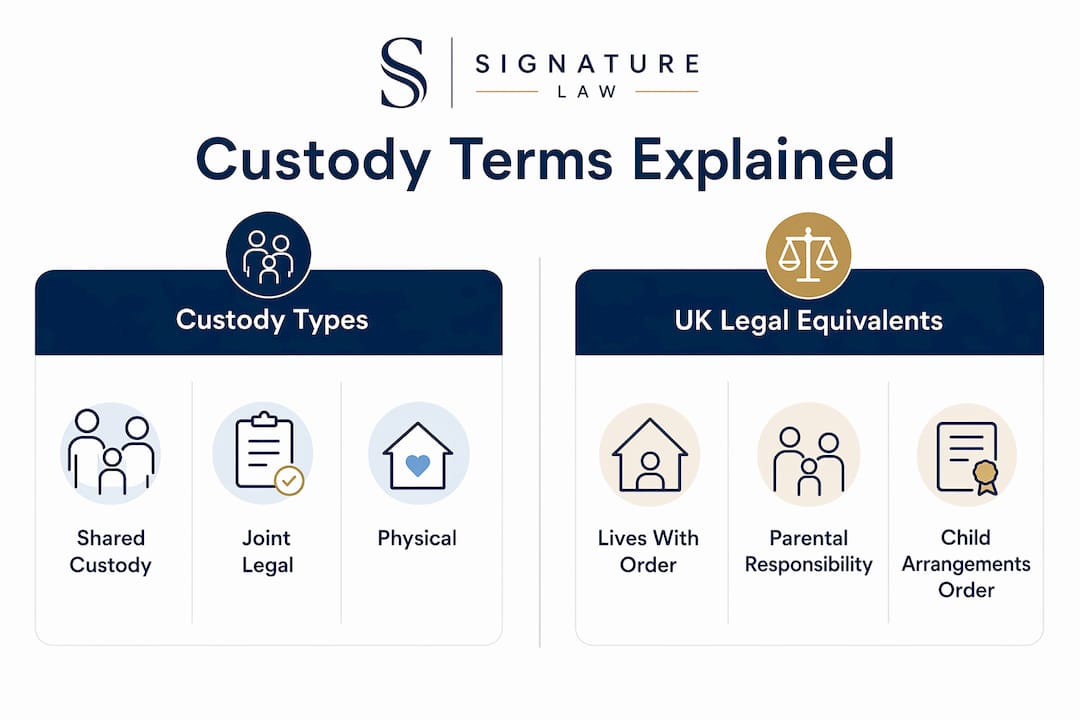
Joint legal custody refers to the shared right and responsibility to make significant decisions about a child’s life, covering education, medical treatment, and religious upbringing. In England and Wales, this concept maps onto “parental responsibility” under the Children Act 1989. Both parents who hold parental responsibility retain it regardless of how time is divided. A child arrangements order does not remove parental responsibility from either parent.
Physical custody refers to where a child actually lives and sleeps. In UK law, this is addressed through the “lives with” element of a Child Arrangements Order. A child can have a “lives with” arrangement with one parent only, or with both parents simultaneously under a shared arrangement.
Shared custody, as commonly understood, combines both elements. It means the child lives with each parent for defined periods and both parents retain equal parental responsibility. Here is how the key terms compare:
| Term | UK legal equivalent | What it covers |
|---|---|---|
| Shared custody | Shared lives with order | Where the child lives and when |
| Joint legal custody | Parental responsibility | Decision-making on education, health, religion |
| Physical custody | Lives with order | Day-to-day residence and care |
| Contact / visitation | Spends time with order | Scheduled time with the non-resident parent |
One further distinction carries real legal weight. A parent named in a “lives with” order can remove a child from jurisdiction for up to 28 days without the other parent’s consent, under section 13 of the Children Act 1989. A parent with only a “spends time with” order does not hold this right. This difference is rarely understood by parents at the outset of negotiations and can become a significant point of dispute.
How do courts decide on shared custody arrangements in the UK?
Courts in England and Wales apply the welfare checklist set out in section 1 of the Children Act 1989 when determining any child arrangements dispute. The child’s best interests are the paramount consideration, not the preferences of either parent.
The court evaluates a range of factors before granting a shared lives with order. These include:
- The child’s physical, emotional, and educational needs.
- The likely effect of any change in circumstances on the child.
- The child’s age, background, and any characteristics the court considers relevant.
- Any harm the child has suffered or is at risk of suffering.
- The capability of each parent to meet the child’s needs.
- The practical logistics of the proposed arrangement, including proximity of homes and school location.
A shared lives with order may be appropriate even where parents are in significant conflict. Appellate guidance from Becket Chambers in 2025 confirms that suitability rests on welfare, not on whether parents cooperate harmoniously. This means a court will not automatically refuse a shared arrangement simply because the parents struggle to communicate. What matters is whether the arrangement serves the child well.
“The court’s focus is not on achieving parental equality in time, but on securing an arrangement that genuinely promotes the child’s welfare and stability.” — Northampton Chambers, 2026
Practical schedules vary considerably. Week-on/week-off arrangements suit older children who can manage longer transitions. Alternating weekends with midweek contact suits younger children who benefit from more frequent contact with both parents. Bespoke timetables for school holidays, birthdays, and special occasions are common. Courts can make tightly defined or flexible orders depending on the family’s circumstances and the child’s needs.
Common misconceptions about shared custody that parents get wrong
The most persistent misconception is that a shared custody arrangement automatically means equal time. It does not. As confirmed in the case of AZ v BX, there is no statutory requirement for a 50/50 split under a shared lives with order. A child spending 60% of nights with one parent and 40% with the other can still be subject to a shared lives with order in relation to both.
A second misconception is that “shared custody” is a distinct legal category that confers special rights. It is not. The term derives from practice and case law, not statute. What matters legally is the precise wording of the Child Arrangements Order and the specific living and time patterns it sets out.
Parents also frequently misunderstand the relationship between shared custody and parental responsibility. Neither parent loses parental responsibility as a result of a child arrangements order, provided they already held it before the order was made. This is a critical point: a parent with a “spends time with” order retains full parental responsibility and the right to be consulted on major decisions about the child’s life.
Pro Tip: Do not conflate the amount of time your child spends with you with the extent of your parental rights. Parental responsibility is separate from the time division in any order. Understanding this distinction prevents unnecessary conflict during negotiations.
A further misunderstanding concerns control. Some parents believe that holding a “lives with” order gives them authority to override the other parent’s decisions. It does not. Both parents with parental responsibility must be consulted on significant matters. The welfare advantage of shared lives with orders lies precisely in preventing one parent from exercising unilateral control and in affirming that both parents hold equal value in the child’s life.
How can separated parents create effective shared custody agreements?
A workable shared parenting agreement starts with clarity, not compromise for its own sake. Vague arrangements create conflict. A well-drafted Child Arrangements Order should specify not only where the child lives and when, but also how transitions are managed, how holidays are divided, and what happens when one parent needs to change the schedule.
Consider these practical elements when building your arrangement:
- School term schedules. Specify which parent handles school drop-offs and collections during each period of care. Consistency around schooling is one of the factors courts weigh most heavily.
- Holiday and special occasion arrangements. Set out Christmas, Easter, and summer holiday divisions in advance. Disputes over holidays are among the most common sources of post-order conflict.
- Transition logistics. Agree on handover locations and times. Neutral locations such as school gates reduce the risk of confrontation.
- Communication protocols. Decide how parents will communicate about the child’s welfare, whether by text, email, or a co-parenting app such as OurFamilyWizard or Talking Parents.
- Review mechanisms. Children’s needs change as they grow. Build in a review point, particularly around school transitions, to reassess whether the arrangement still serves the child well.
Evidence shows that child welfare depends on stability and consistent logistics far more than on achieving parental time parity. A parent who insists on a 50/50 split without considering school proximity, work patterns, or the child’s established routines is prioritising their own interests over their child’s. Courts notice this, and it affects outcomes.
Mediation is a valuable first step before any court application. A trained family mediator can help both parents reach a shared parenting agreement that reflects the child’s actual needs. For guidance on child custody arrangements in England and Wales, taking early legal advice ensures any agreement you reach is both workable and legally sound.
Key takeaways
Shared custody in UK law is defined by the child’s welfare, not by equal time, and both parents retain parental responsibility regardless of how nights are divided.
| Point | Details |
|---|---|
| No automatic 50/50 split | A shared lives with order does not require equal time; welfare determines the division. |
| “Shared custody” is a practitioner term | It has no statutory definition; courts use “lives with” and “spends time with” language. |
| Parental responsibility is retained | Neither parent loses parental responsibility solely because of a child arrangements order. |
| Welfare overrides parental preference | Courts apply the section 1 welfare checklist, not parental claims to equal time. |
| Clarity in orders prevents conflict | Detailed, specific orders covering holidays, transitions, and logistics reduce post-order disputes. |
Why clarity matters more than equality in shared custody
Having worked alongside separated parents navigating child arrangements for many years, the pattern I see most often is this: parents arrive focused on time. They want 50/50. They see it as fairness. What they often miss is that the court is not a referee in a fairness contest between adults. It is a forum for determining what genuinely serves the child.
The parents who reach the best outcomes are not always those who fight hardest for equal nights. They are the ones who come prepared with a realistic, child-centred proposal. They have thought about school runs, about their child’s friendships, about what happens when the child is unwell. They have considered whether their proposed schedule actually fits their working hours. That level of preparation signals to a court that a parent is thinking about the child, not about winning.
I also see parents underestimate the value of a precisely worded order. A vague arrangement, even one agreed between both parties, becomes a source of conflict the moment one parent’s circumstances change. The order that specifies exactly which parent collects from school on which days, and what happens over the August bank holiday, is the order that holds. Ambiguity is not flexibility. It is a future argument waiting to happen.
Seek legal advice early. Not because the process is adversarial, but because getting the foundations right at the outset protects your child from the disruption of returning to court later. The family law terminology alone can be confusing enough to cause misunderstandings that derail otherwise sensible negotiations.
— George
How Signaturelaw can help with shared custody and child arrangements
Signaturelaw is a UK family law firm founded by solicitor Sital Somaiya, who brings over 15 years of experience and has been featured on BBC and ITV. The firm provides bespoke, compassionate legal support to parents navigating child arrangements after separation, including advice on shared lives with orders, parental responsibility, and contested custody proceedings. Signaturelaw offers fixed-fee initial consultations, Legal Aid for eligible clients, and multilingual support. Whether you need help drafting a workable shared parenting agreement or representation at a contested hearing, the team is here to guide you. Explore Signaturelaw’s family law services or contact the firm directly to speak with a solicitor today.
FAQ
What does shared custody mean in the UK?
Shared custody means a child lives with both parents for defined periods under a Child Arrangements Order made pursuant to section 8 of the Children Act 1989. It does not require an equal division of time and is not a formal statutory category.
Is shared custody the same as joint custody?
The terms are often used interchangeably, but in UK law the relevant concepts are parental responsibility (decision-making) and a shared lives with order (physical residence). Both parents retain parental responsibility regardless of the time split in any order.
Does shared custody mean 50/50 time with each parent?
No. As confirmed in AZ v BX, there is no legal requirement for equal time under a shared lives with order. The division of time is determined by the child’s welfare, not by parental preference for equality.
Can a court grant shared custody if parents do not get along?
Yes. Courts can grant a shared lives with order even where parents are antagonistic, provided the arrangement serves the child’s welfare. Parental conflict alone is not a bar to a shared order.
How do I formalise a shared custody arrangement?
You can apply for a Child Arrangements Order through the family court, or reach an agreement through mediation and have it approved by the court as a consent order. Signaturelaw’s child arrangement solicitors can advise you on the most appropriate route for your circumstances.
Recommended
- Understanding Child Custody Arrangements
- Property division in UK divorce: fair outcomes explained | Signature Law
- Can a Mother Legally Stop a Father from Seeing His Child in the UK? Understanding Father’s Rights and Child Contact Laws
- Asset division in UK divorce settlements: what to expect | Signature Law