





Family Law
Step by step divorce process in the UK: 2026 guide

TL;DR:
- The divorce process in England and Wales follows a structured legal timeline with mandatory 26-week minimums, including reflection and waiting periods. It involves online application, serving papers, obtaining Conditional and Final Orders, and securing a legally binding financial settlement through a Consent Order. Proper planning, legal advice, and addressing financial matters early can simplify procedures and protect your interests.
The step by step divorce process in England and Wales is a structured legal procedure governed by the Divorce, Dissolution and Separation Act 2020, with mandatory minimum timelines of 26 weeks from application to final order. Understanding each stage clearly reduces anxiety, protects your financial position, and helps you make informed decisions at every turn. This guide covers eligibility, the online application, the reflection period, the Conditional Order, the Final Order, and the critical but often overlooked step of securing a financial settlement. Whether you are considering filing or have already started, you will find practical clarity here.
What are the eligibility criteria and documents you need?
Before you can begin the legal steps in divorce, you must meet specific eligibility requirements set by the courts in England and Wales. The marriage must have lasted at least one year. At least one spouse must be domiciled in England or Wales, or have been habitually resident there for at least 12 months immediately before the application.
The single most important document you need is your original marriage certificate or a certified copy. Without it, the court will not process your application. If your certificate is in a foreign language, you will need a certified translation.
The court fee to file for divorce is £593, payable online at the time of application. That is a significant sum, and many people are unaware that relief is available. If you are on a low income or receiving certain benefits, you can apply for a reduction or full waiver using form EX160, known as the Help with Fees scheme.
Key eligibility and document requirements at a glance:
- Marriage must have lasted at least one year
- At least one spouse domiciled or habitually resident in England or Wales
- Original or certified copy of the marriage certificate
- Court fee of £593 (reductions available via Help with Fees form EX160)
- Both spouses’ full legal names, addresses, and dates of birth
- Details of any dependent children
Pro Tip: Apply for Help with Fees before you submit your divorce application. You cannot claim the reduction retrospectively once the fee has been paid.
How do you complete the online application and serve papers?
The HMCTS online divorce service guides you through the application step by step, saving your progress at each stage so you can return if needed. You will need to create an account on the HMCTS portal before you begin. The process is straightforward, but accuracy matters. Errors in names, dates, or addresses can cause delays.
Here is what the online application process looks like in practice:
- Create your HMCTS account. Register at the official HMCTS divorce portal using a valid email address.
- Choose sole or joint application. A joint application is generally less contentious and cheaper because both spouses submit together and share the court fee. A sole application means one spouse applies and serves the other.
- Enter personal details. Provide full legal names, addresses, dates of birth, and the date and place of marriage.
- Upload your marriage certificate. A scanned certified copy is acceptable at this stage.
- Complete the marriage breakdown statement. Under the no-fault divorce law, you simply state that the marriage has broken down irretrievably. You do not need to assign blame or cite specific conduct.
- Pay the court fee. Pay online by card or submit your Help with Fees reference number.
- Submit and await confirmation. The court issues an acknowledgement and serves the application on the respondent.
Once the application is served, the respondent has 14 days to acknowledge receipt. Failure to respond within this window can delay proceedings and may require the applicant to seek alternative service methods through the court.
Pro Tip: If your spouse is unlikely to respond promptly, consider a joint application from the outset. It removes the acknowledgement risk entirely and keeps the process moving.

What happens during the mandatory 20-week reflection period?
After the court issues the application, a mandatory 20-week waiting period begins before you can apply for the Conditional Order. This period exists to give both parties time to reflect on whether the marriage has genuinely broken down and to consider reconciliation if appropriate. The law treats this as a meaningful pause, not a formality.
The reflection period is also the most productive time to address the two issues that sit alongside divorce but are legally separate from it: financial arrangements and child contact. Many people make the mistake of waiting until after the divorce is finalised to tackle these matters. That approach costs time and money.
During the 20-week period, you should consider the following:
- Financial disclosure. Both parties should begin exchanging full details of their assets, income, debts, and pensions. This is the foundation of any fair financial settlement.
- Negotiation or mediation. If you and your spouse can agree on finances and child arrangements without going to court, the process is faster and far less expensive. Mediation through a qualified family mediator is a recognised and effective route.
- Child arrangements. Agree on where children will live, how much time they spend with each parent, and how decisions about their upbringing will be made. A formal Child Arrangement Order can be applied for if agreement is not possible.
- Legal advice. Even if your divorce is amicable, taking independent legal advice during this period protects you from agreeing to terms that are not in your best interests.
Disputes over finances that are left unresolved before applying for a Consent Order frequently result in delays and significantly higher costs. Using the reflection period wisely is one of the most practical things you can do to protect yourself.
How and when do you apply for the Conditional Order and Final Order?
Once the 20-week reflection period has passed, you can apply to the court for the Conditional Order. This is the first of two formal court orders that mark the legal progression of your divorce.
The Conditional Order confirms that the court sees no legal reason why the divorce cannot proceed. It does not end the marriage. It was previously known as the Decree Nisi. The court reviews the application and, if satisfied, pronounces the Conditional Order. You do not usually need to attend a hearing for this.
After the Conditional Order is granted, you must wait a further six weeks and one day before you can apply for the Final Order. The Final Order legally ends the marriage. It was previously called the Decree Absolute.
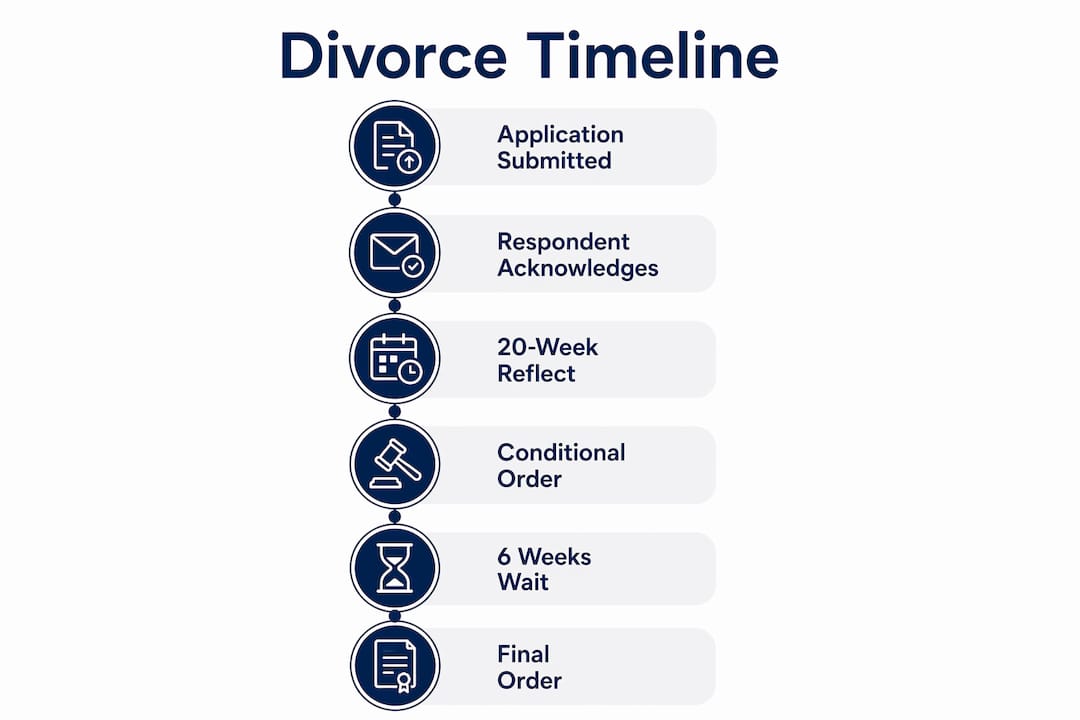
The table below summarises the key stages and their minimum timescales:
| Stage | Minimum timeframe from previous stage |
|---|---|
| Application submitted | Day 0 |
| Respondent acknowledgement window | 14 days |
| Conditional Order application opens | 20 weeks from application |
| Conditional Order granted | Court processing time (varies) |
| Final Order application opens | 6 weeks and 1 day after Conditional Order |
| Total minimum timeline | 26+ weeks |
Court delays can extend this timeline further, particularly at the Conditional Order stage. If you apply for the Final Order more than 12 months after the Conditional Order, you must provide the court with a written explanation for the delay.
One important point: do not apply for the Final Order until your financial settlement is agreed and a Consent Order has been submitted to the court. Finalising the divorce before securing a financial order can leave you exposed to future claims from your former spouse.
How do divorce financial orders work and why does a Consent Order matter?
Divorce ends the legal status of your marriage. It does not automatically sever your financial ties. This distinction is one of the most misunderstood aspects of the entire process, and it catches many people out.
Without a formal financial order, your former spouse can make financial claims against you years after the divorce is finalised. A Consent Order is the legal document that makes your agreed financial settlement binding and enforceable. It covers the division of property, savings, pensions, and any ongoing maintenance payments.
The table below compares the two positions clearly:
| Position | Without a Consent Order | With a Consent Order |
|---|---|---|
| Financial claims | Remain open indefinitely | Legally closed and enforceable |
| Future risk | Former spouse can claim against assets | Clean break legally protected |
| Property transfers | Not legally protected | Formally recorded and binding |
| Pension sharing | Cannot be implemented | Implemented via Pension Sharing Order |
To obtain a Consent Order, both parties must complete Form D81, a statement of financial information. This document discloses all assets, income, and liabilities. The court reviews it to confirm the agreement is fair before approving the order. You do not need to attend court for this process in most cases.
Pro Tip: Even if you and your spouse agree on everything, always formalise the agreement in a Consent Order. A verbal agreement or written letter has no legal force. Only a court-approved Consent Order gives you a genuine clean break.
If you cannot agree on financial matters, you may need to apply for a Financial Remedy Order through the court. This is a more formal and costly process, but it gives the court the power to impose a fair settlement. You can read more about family law terminology to understand the specific legal terms used in financial proceedings.
Key takeaways
The step by step divorce process in England and Wales requires a minimum of 26 weeks, structured legal stages, and a separate financial order to achieve a complete and protected legal separation.
| Point | Details |
|---|---|
| Minimum divorce timeline | The process takes at least 26 weeks from application to Final Order. |
| Eligibility requirements | Marriage must be at least one year old and one spouse must be domiciled in England or Wales. |
| Use the reflection period | The 20-week wait is the best time to negotiate finances and child arrangements. |
| Conditional Order is not the end | It confirms the court approves the divorce but does not legally end the marriage. |
| Consent Order is not optional | Without one, financial claims against you remain open indefinitely after divorce. |
Why the process is more manageable than most people fear
I have worked with clients at every stage of the divorce process, and the single biggest source of distress is not the legal steps themselves. It is the uncertainty. People arrive convinced that divorce is an adversarial courtroom battle. In the vast majority of cases, it is not.
The no-fault divorce law, introduced in April 2022, removed the requirement to assign blame. That change alone has made the process considerably less confrontational. Most divorces in England and Wales now proceed without a court hearing at all. The online HMCTS portal handles the administrative stages, and the court only becomes directly involved if there is a dispute over finances or children.
What I consistently advise clients is this: treat the 20-week reflection period as your working window, not dead time. The couples who use it to reach agreement on finances and child arrangements are the ones who complete the process with the least disruption to their lives. Those who wait until after the Final Order to address financial matters almost always face longer timelines and higher costs.
The emotional weight of divorce is real, and it deserves acknowledgement. But legal clarity is not the enemy of emotional recovery. Knowing exactly where you stand, what comes next, and what your rights are gives you a foundation to move forward from. If you are unsure about any stage of the process, taking early legal advice is the single most cost-effective decision you can make. You can explore the full family law proceedings timeline to understand how each stage connects.
— George
How Signaturelaw can support you through every stage
Signaturelaw is a UK family law firm founded by solicitor Sital Somaiya, who brings over 15 years of experience and has been featured on BBC and ITV. The firm provides clear, compassionate legal support at every stage of the divorce process, from the initial application through to financial settlements and child arrangements. Legal Aid is available for eligible clients, and fixed-fee consultations mean you know your costs from the outset. Multilingual advice is also available. Whether your situation is straightforward or complex, Signaturelaw offers the kind of personalised support that a volume-based firm simply cannot provide. To speak to a family law solicitor about your divorce, contact Signaturelaw today.
FAQ
How long does the divorce process take in England and Wales?
The minimum total timeline is 26 weeks, comprising a 20-week reflection period and a further six weeks and one day after the Conditional Order. Court delays and unresolved financial disputes can extend this considerably.
Can I apply for divorce without a solicitor?
Yes. The HMCTS online portal allows you to apply without legal representation. However, taking legal advice, particularly regarding financial settlements and Consent Orders, is strongly recommended to protect your long-term position.
What is the difference between a Conditional Order and a Final Order?
The Conditional Order confirms the court sees no reason the divorce cannot proceed but does not end the marriage. The Final Order legally dissolves the marriage and is the document you need to remarry.
Do I need a Consent Order if my spouse and I agree on finances?
Yes. A verbal or written agreement between spouses has no legal force. Only a court-approved Consent Order makes the financial settlement binding and prevents future claims against your assets.
What if my spouse does not respond to the divorce application?
The respondent has 14 days to acknowledge the application. If they do not respond, you may need to apply to the court for alternative service or seek a deemed service order, which can delay proceedings. A joint application avoids this risk entirely.
Recommended
- Step-by-step UK divorce process: Essential guide for 2026 | Signature Law
- How to get a divorce in the UK: Step-by-step guide 2026 | Signature Law
- Your essential divorce checklist for the UK: Step-by-step guide | Signature Law
- Legal Aid Divorce Workflow: Step-by-Step Guide for UK Clients | Signature Law