





Family Law
How to apply for probate: step-by-step UK guide
Losing someone close is one of life’s most difficult experiences, and being named as an executor can add a layer of pressure that feels overwhelming. Suddenly, you are responsible for managing an estate, dealing with financial institutions, and navigating legal requirements at a time when grief is still raw. Many executors worry they will make a costly mistake or miss a critical deadline. This guide walks you through every stage of the probate process in England and Wales, from confirming whether probate is needed to receiving the grant and administering the estate, so you can move forward with clarity and confidence.
Table of Contents
- What is probate and when is it required?
- Preparing to apply for probate: documents and requirements
- The probate application process: step-by-step
- Common challenges and special circumstances
- DIY probate or solicitor support: choosing the right route
- What to expect after applying: timeframes and next steps
- Get support from trusted probate solicitors
- Frequently asked questions
Key Takeaways
| Point | Details |
|---|---|
| Probate not always needed | You may be able to handle an estate without probate if assets are joint or under certain thresholds. |
| Careful preparation pays off | Having all documents and valuations ready prevents delays during the probate process. |
| Apply online for speed | Online applications are typically processed faster than postal applications. |
| Complex cases need expert help | Solicitors are invaluable for estates with disputes, foreign assets, or high values. |
What is probate and when is it required?
Probate is the legal process by which a court confirms an executor’s authority to deal with a deceased person’s estate. In practical terms, it means obtaining a Grant of Probate, a formal document that allows you to access bank accounts, sell property, and distribute assets to beneficiaries.
Not every estate requires probate, and understanding this early saves considerable time. As a general rule, probate is not needed for estates under £5,000 or where assets are jointly owned and pass automatically to the surviving owner. Named beneficiaries on life insurance policies or pension schemes also fall outside the probate requirement, as those assets transfer directly.
Here is a quick reference to help you decide:
| Situation | Probate likely needed? |
|---|---|
| Sole-owned property or land | Yes |
| Bank account over £50,000 (sole name) | Usually yes |
| Jointly owned assets | No |
| Named beneficiary on insurance/pension | No |
| Estate under £5,000 | No |
Key circumstances where probate is not required:
- Assets held in joint names that pass by survivorship
- Small bank accounts below the institution’s internal threshold (typically £5,000 to £50,000)
- Assets held in trust
- Life insurance or pension funds with a named beneficiary
Important: Rules differ in Scotland (where the process is called Confirmation) and Northern Ireland. This guide focuses on England and Wales only.
Before proceeding, use our probate checklist to confirm whether an application is necessary in your specific circumstances.
Preparing to apply for probate: documents and requirements
Once you have confirmed that probate is required, preparation is everything. Rushing this stage is one of the most common reasons applications are delayed or rejected.

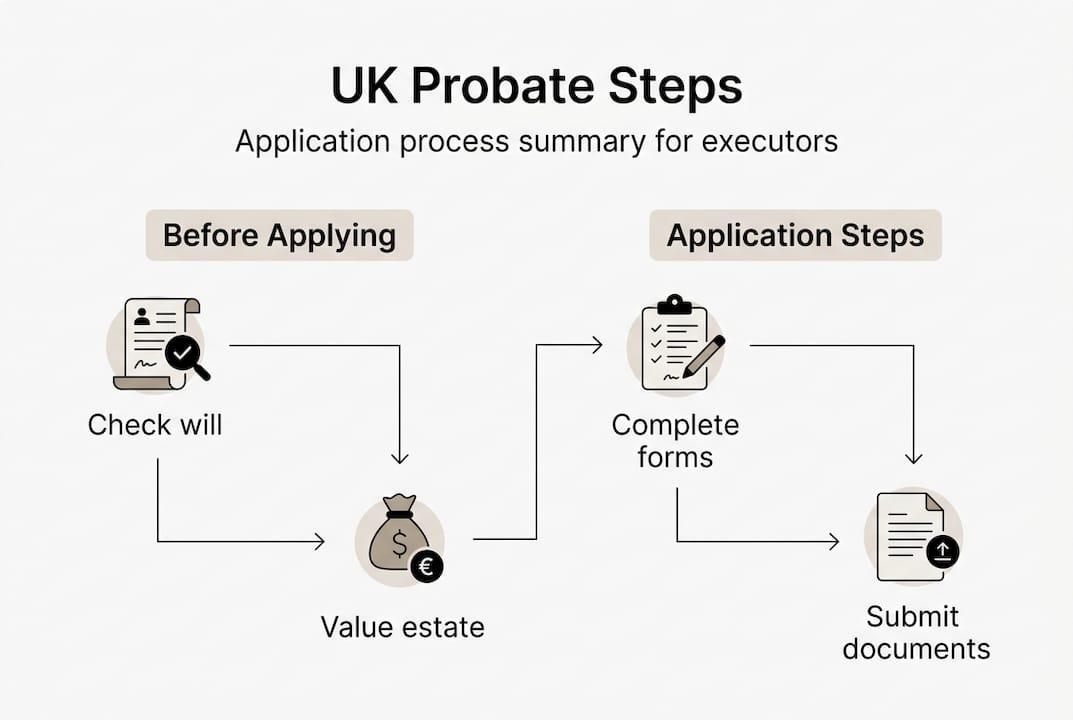
As outlined by HMCTS, executors must register the death, locate the will, value the estate, and report to HMRC before submitting a probate application. Each of these steps carries its own requirements.
Documents and information you will need:
- The original death certificate (or certified copy) from the Registrar
- The original will and any codicils (amendments to the will)
- A full valuation of the estate, including all assets and outstanding debts
- Details of all beneficiaries named in the will
- Property information, including mortgage balances
- Bank, investment, and pension account details
Inheritance Tax (IHT) forms are a critical part of preparation. The form you use depends on the estate’s value and complexity:
| Estate type | IHT form required |
|---|---|
| Excepted estate (low value/simple) | IHT205 |
| Larger or more complex estate | IHT400 |
For guidance on which form applies to you, our page on probate form types explains each option clearly.
Pro Tip: Request at least ten certified copies of the death certificate from the Registrar. Banks, insurers, and HMRC each require their own copy, and ordering extras upfront avoids frustrating delays later.
For a broader overview of your responsibilities at this stage, our guide on handling probate covers the executor’s role in detail.
The probate application process: step-by-step
With your paperwork in order, you can move through the application itself. The process follows a clear sequence.
- Complete and submit IHT forms to HMRC. If Inheritance Tax is due, you must pay at least the first instalment before probate can be granted. Interest accrues on unpaid IHT after six months from the date of death.
- Obtain an IHT reference number from HMRC, which you will need for your probate application.
- Apply online or by post. The online route via MyHMCTS is strongly recommended. According to the gov.uk probate application guidance, the current application fee is £300 for estates over £5,000, with no fee for smaller estates.
- Submit the original will along with your application. Keep a certified copy for your own records.
- Sign a statement of truth (previously known as the executor’s oath), confirming the accuracy of the information provided.
- Await the grant. Online applications are typically processed in 4 to 6 weeks; postal applications can take 8 to 16 weeks.
Pro Tip: Publish a statutory notice to creditors in The Gazette before distributing the estate. This two-month notice period protects you as executor from personal liability if unknown debts surface after distribution.
Processing times at a glance: Online: 4 to 6 weeks. By post: 8 to 16 weeks.
For a more detailed walkthrough, our probate step-by-step process guide covers each stage with practical examples. You can also review our page on types of probate forms if you are unsure which application form applies.
Common challenges and special circumstances
Even well-prepared executors encounter obstacles. Knowing what to expect means you can respond calmly rather than reactively.
Lost or missing will: If the original will cannot be found, you can still apply for probate using a copy, but you must submit a supporting affidavit explaining the circumstances. The lost will process is more complex and typically takes longer. As the government guidance confirms, lost wills and executor incapacity can significantly slow the process, and court removal of an executor, while rare, is possible in serious cases.
Common challenges executors face include:
- Executor dies or loses capacity before the grant is issued. In this situation, a beneficiary may apply for Letters of Administration with the will annexed.
- Disputed wills or contested estates. A beneficiary or creditor can lodge a caveat at the Probate Registry, which temporarily halts the application.
- Foreign assets or property abroad. These require specialist legal handling and may involve separate probate proceedings in another jurisdiction.
- Insolvent estates, where debts exceed assets. Strict rules govern the order in which creditors must be paid.
“Disputes and caveats can bring the entire administration to a standstill. Acting quickly and seeking legal advice at the first sign of conflict is always the right approach.”
If you are facing a contested situation, our guide on probate disputes explains your options and the steps involved.
DIY probate or solicitor support: choosing the right route
Many executors successfully manage probate themselves, particularly for straightforward estates. Others find that professional support is not just helpful but essential.
When DIY probate is realistic:
- The estate is modest and clearly defined
- There is a valid, uncontested will
- All assets are in the UK
- There are no disputes between beneficiaries
- You have the time and confidence to manage paperwork carefully
When a solicitor adds real value:
- The estate includes property, business interests, or overseas assets
- There is no will (intestacy rules apply)
- Beneficiaries are in dispute
- The estate is potentially insolvent
- You are an executor with limited time or legal knowledge
A useful comparison:
| Approach | Cost | Best for |
|---|---|---|
| DIY probate | £300 court fee only | Simple, low-risk estates |
| Solicitor-managed | 1 to 5% of estate value | Complex or disputed estates |
| Fixed-fee solicitor | Agreed upfront | Executors wanting cost certainty |
Pro Tip: Even if you plan to manage probate yourself, a single fixed-fee consultation with a solicitor at the outset can identify risks you may not have considered, and could save you significant time and money.
For a clear view of the full process, our probate workflow guide and estate administration guidance are both worth reviewing before you decide.
What to expect after applying: timeframes and next steps
Receiving the Grant of Probate is a significant milestone, but it is not the end of your responsibilities as executor. Estate administration continues well beyond this point.
Key timeframes to plan around:
| Stage | Typical timeframe |
|---|---|
| Online probate application | 4 to 6 weeks |
| Postal probate application | 8 to 16 weeks |
| Statutory creditor notice period | 2 months |
| Full estate administration | 6 to 18 months |
Once the grant arrives, your next steps are:
- Notify all relevant institutions (banks, HMRC, pension providers, insurers) and provide certified copies of the grant.
- Collect all assets into an executor’s account before distributing to beneficiaries.
- Settle all debts and liabilities, including any outstanding IHT. Remember, interest accrues on unpaid IHT after six months from the date of death.
- Wait out the statutory creditor notice period of two months before making final distributions.
- Prepare estate accounts showing all income, expenditure, and distributions, and share these with beneficiaries.
- Distribute the estate in accordance with the will.
You can track your application’s progress through the MyHMCTS portal if you applied online. For a full breakdown of timelines, our probate timeline guide provides a realistic picture of what to expect at each stage, including factors that can cause delays.
Get support from trusted probate solicitors
Probate is manageable, but it carries real legal and financial responsibility. If you are dealing with a complex estate, a family dispute, or simply want the reassurance that everything is being handled correctly, professional support makes a genuine difference. At Signature Law, our experienced probate solicitors work with executors across Romford, East London, and Essex, providing clear, compassionate guidance at every stage. Whether you need help understanding the difference between probate and will clarity, or you are looking for dedicated Upminster probate solicitors or Romford probate experts, we are here to help. Contact us today to speak with a member of our team.
Frequently asked questions
How long does it take to get probate in the UK in 2026?
Online applications are usually processed in 4 to 6 weeks, while postal applications may take 8 to 16 weeks depending on workload at the Probate Registry.
Is probate always needed to access a UK estate?
No. If all assets are jointly owned or the estate is very small, typically below £5,000, probate is usually not required and assets can pass without a formal grant.
What documents do I need before applying for probate?
You need the death certificate, the original will, a full estate valuation, the relevant IHT forms submitted to HMRC, and details of all beneficiaries and outstanding debts.
What happens if the original will is lost?
You can apply using a copy of the will alongside a supporting affidavit, but the lost will process is more involved and typically takes longer than a standard application.
When should I use a solicitor for probate?
For complex estates, disputes, or overseas assets, a solicitor is strongly advisable. Solicitor fees typically range from 1 to 5% of the estate value, but the protection they provide often outweighs the cost. Contact Signature Law to discuss your situation.
Recommended
- Probate Process Step By Step UK 2026: 92% Online Success | Signature Law
- Probate checklist UK 2026: essential guide to navigate probate | Signature Law
- Navigate the probate application workflow in UK 2026 | Signature Law
- Types of probate forms in the UK: complete guide 2026 | Signature Law