





Family Law
How to get a divorce in the UK: Step-by-step guide 2026

Divorce is one of the most significant decisions you will ever face, and it is entirely normal to feel overwhelmed by the legal process, the financial implications, and the emotional weight of it all. You are far from alone: 102,678 divorces were recorded in England and Wales in 2023, with the median marriage lasting 12.7 years before breakdown. Whether you are just beginning to consider your options or are ready to take the first formal step, this guide will walk you through eligibility, the legal process, financial settlements, and the emotional support available to you, so that you can move forward with clarity and confidence.
Table of Contents
- Who can apply for divorce in the UK?
- The legal process: No-fault divorce and key steps
- Financial settlements: Protecting your assets and interests
- Emotional support, mediation, and getting professional help
- Family law expertise for your next steps
- Frequently asked questions
Key Takeaways
| Point | Details |
|---|---|
| Eligibility clarified | You must be married at least one year, with legal recognition and residency in England or Wales. |
| No-fault process | Divorce proceedings in 2026 don’t require blaming either party, just proof of irretrievable breakdown. |
| Out-of-court settlements | Most financial and property divisions are settled through negotiation or mediation without court intervention. |
| Support matters | Emotional support, mediation, and legal advice are critical for a smooth process, especially with complex finances or children. |
| Expert legal guidance | Specialist solicitors help protect assets, simplify paperwork, and ensure fair outcomes throughout your divorce. |
Who can apply for divorce in the UK?
Before anything else, it is important to confirm that you meet the legal requirements to apply. Not everyone is immediately eligible, and understanding the criteria upfront saves time and prevents unnecessary stress.
According to government guidance, you must meet all of the following conditions:
- You must have been married for at least one year before you can apply
- Your marriage must be legally recognised in the UK
- You or your spouse must be domiciled or habitually resident in England or Wales
- You must be able to demonstrate that the marriage has irretrievably broken down
Residency is a particularly important point. If you or your spouse lives abroad but retains domicile in England or Wales, you may still qualify. It is worth checking your legal aid eligibility early, as financial support may be available to help cover legal costs.
| Eligibility requirement | Detail |
|---|---|
| Minimum marriage duration | At least 1 year |
| Marriage recognition | Legally recognised in the UK |
| Residency or domicile | England or Wales (one or both parties) |
| Ground for divorce | Irretrievable breakdown only |
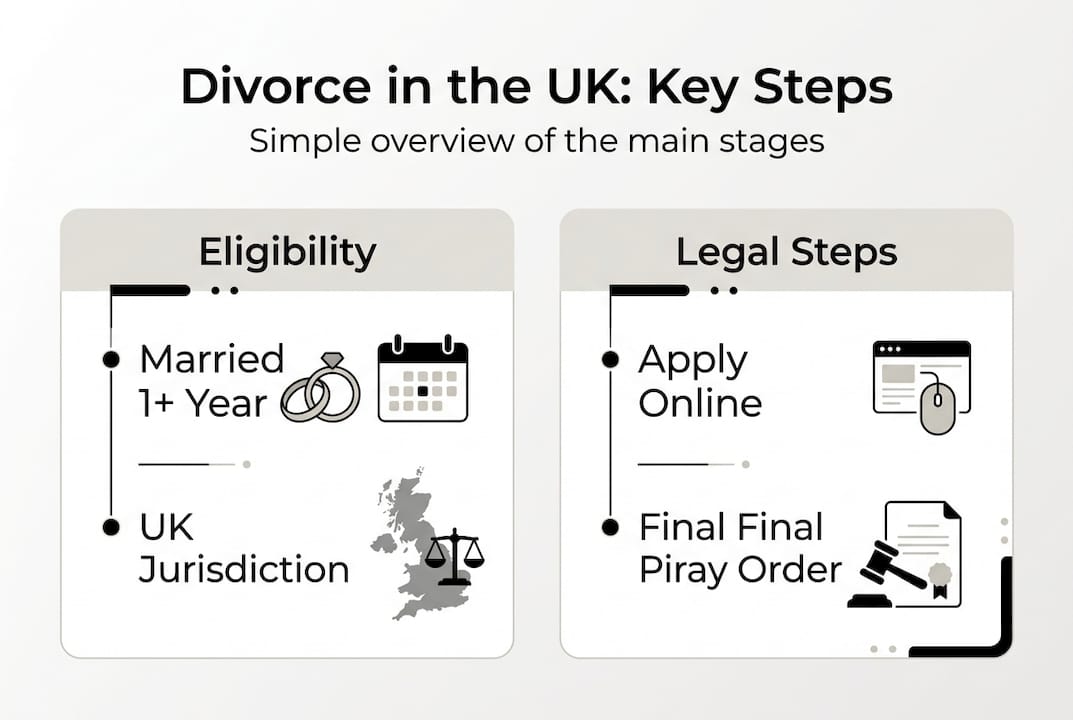
The introduction of no-fault divorce in April 2022 was a landmark change. You no longer need to blame your spouse or cite specific behaviour to justify the breakdown. This has made the process considerably less adversarial and, for many couples, far less distressing.
Pro Tip: Gather your original marriage certificate before you begin. You will need it to submit your application, and obtaining a replacement can add weeks to your timeline.
If you are unsure whether you qualify or want to understand the divorce steps timeline before committing, speaking to a solicitor at the earliest stage is always advisable.
The legal process: No-fault divorce and key steps
Once eligibility is confirmed, the next step is understanding how the modern UK divorce process works. The good news is that the no-fault system, introduced in April 2022, has simplified proceedings considerably.
Irretrievable breakdown is now the sole ground for divorce in England and Wales, and you are not required to prove fault, assign blame, or cite specific incidents. This removes a significant source of conflict from what is already a difficult process.
The process follows three clear stages:
- Application — Submit a sole or joint application to the court, along with your marriage certificate and the court fee (currently £593 in 2026). Joint applications, where both parties apply together, tend to move more smoothly and reduce the risk of disputes.
- Conditional order — Previously known as the decree nisi, this is the court’s confirmation that there is no reason why the divorce cannot proceed. There is a mandatory 20-week reflection period between the application and applying for the conditional order.
- Final order — Previously known as the decree absolute, this legally ends the marriage. You must wait at least six weeks after the conditional order before applying for the final order.
| Stage | Former name | Key action |
|---|---|---|
| Application | Petition | Submit to court with marriage certificate |
| Conditional order | Decree nisi | Court confirms no legal barrier |
| Final order | Decree absolute | Marriage legally dissolved |
The typical timeline from application to final order is 26 to 39 weeks for straightforward cases. Complex financial or child arrangement disputes can extend this considerably.
Pro Tip: Do not apply for the final order until your financial settlement is agreed and formalised. Finalising the divorce before sorting finances can affect pension rights and inheritance entitlements.
For those who may qualify for state-funded support, understanding the legal aid workflow can help you access representation without prohibitive upfront costs. You can also find further practical guidance on the Signature Law blog.
Financial settlements: Protecting your assets and interests
With the legal process underway, it is crucial to plan how assets will be shared and protected during and after divorce. Financial settlements are often the most complex and emotionally charged aspect of the entire process.
A financial settlement covers everything of value accumulated during the marriage, including:
- Property, including the family home and any investment properties
- Pensions, which are frequently the most valuable asset and often overlooked
- Savings and investments, including ISAs, shares, and cash accounts
- Business interests, where one or both parties own or co-own a business
- Maintenance payments, particularly where one party has significantly lower income
Settlements are governed by the Matrimonial Causes Act 1973, which sets out the factors a court must consider. These include the needs of both parties, their respective contributions, the welfare of any children, and the standard of living enjoyed during the marriage. Crucially, around 70% of settlements are reached without going to court, through negotiation or mediation.
A clean break order is a legally binding agreement that severs all future financial ties between you and your former spouse. Without one, either party could make financial claims against the other years after the divorce is finalised.
| Settlement method | Typical use | Court involvement |
|---|---|---|
| Negotiation via solicitors | Most common approach | Minimal |
| Mediation | Amicable cases | None unless disputed |
| Collaborative law | Both parties willing | None |
| Court proceedings | Contested cases | Full |
Pro Tip: Even if you and your spouse agree on finances informally, you must obtain a consent order from the court to make the agreement legally binding. A verbal or written agreement between you is not enforceable without court approval.
For those aged 30 to 55, pensions deserve particular attention. Many people in this age group have accumulated significant pension savings, and failing to address them properly can leave one party significantly worse off in retirement. Our dedicated guide on pensions and divorce explains the options available, including pension sharing orders and pension offsetting. You can also read more in our financial settlement guide.
Emotional support, mediation, and getting professional help
Alongside legal and financial steps, emotional support and professional guidance are equally important for a healthy transition. Divorce affects every area of your life, and it is entirely reasonable to seek help beyond the purely legal.
Prioritising your emotional wellbeing is not a luxury; it is a practical necessity. When you are under significant stress, decision-making suffers, and that can have real consequences in legal and financial negotiations.
Here are the key sources of support available to you:
- NHS counselling — Free or low-cost talking therapy is available through your GP. NHS counselling services can provide structured emotional support during and after separation.
- Mediation — A trained, neutral mediator helps both parties reach agreement on finances and children without going to court. It is typically faster and less expensive than litigation.
- Support groups and charities — Organisations such as Relate and Citizens Advice offer guidance, peer support, and practical information for those going through separation.
- Solicitor support — For anything involving complex finances, property, pensions, or children’s arrangements, professional legal advice is not optional. It is essential.
Women going through divorce, particularly those aged 30 to 55 who may have taken career breaks or reduced working hours to care for children, are statistically more likely to be financially disadvantaged without proper legal advice. The same applies to anyone whose spouse managed the household finances during the marriage.
Pro Tip: If you and your spouse are on reasonable terms, a joint application combined with mediation is the most efficient route. It reduces legal costs, shortens timelines, and tends to produce more durable agreements because both parties feel heard.
It is also worth considering how divorce intersects with your broader estate planning. Updating your will, reviewing beneficiary nominations on pensions and life insurance, and reconsidering lasting powers of attorney are all steps that should be taken promptly. Our guide on estate planning in divorce covers these considerations in detail.
Family law expertise for your next steps
Navigating divorce is rarely straightforward, but you do not have to face it alone. At Signature Law, we combine over 15 years of family law experience with a genuinely compassionate approach, because we understand that behind every case is a person going through one of the hardest periods of their life. Our founder, Sital Somaiya, has been featured on BBC and ITV, and our team is experienced in everything from straightforward no-fault divorces to complex financial proceedings involving property, pensions, and business interests. We offer fixed-fee initial consultations, Legal Aid for eligible clients, and multilingual support. To understand the broader family law impact of your situation, or to get specialist guidance on property division, we are here to help. Contact Signature Law today to speak with a solicitor who will listen, advise, and support you every step of the way.
Frequently asked questions
Can I get a divorce in the UK if I was married abroad?
Yes, provided your marriage is legally recognised in the UK and you or your spouse is habitually resident or domiciled in England or Wales. The country where you married does not prevent you from divorcing here.
Is there a minimum separation period before divorce?
No. Since April 2022, there is no required separation period. You simply need to have been married for at least one year and be able to state that the marriage has irretrievably broken down.
Do I need to disclose all finances and assets during divorce?
Yes. Full financial disclosure is a legal requirement in financial proceedings. Failing to disclose assets can result in any agreement being set aside by the court, as settlements must reflect the Matrimonial Causes Act 1973 factors fairly.
What if my spouse does not agree to divorce?
Under the no-fault system, you can apply as a sole applicant. The process will proceed even without your spouse’s agreement, though joint applications remain faster and less contentious where cooperation is possible.
How long does it take to finalise a divorce in the UK?
Most divorces are resolved within 26 to 39 weeks from application to final order. Cases involving contested finances or child arrangements can take considerably longer, which is why early legal advice is so valuable.
Recommended
- Legal Aid Divorce Workflow: Step-by-Step Guide for UK Clients | Signature Law
- Signature Law Blog: Legal Insights & Updates (2026)
- Steps in Family Law Proceedings: A Complete Timeline Guide for UK Cases
- Divorce Settlement Explained – Fair Outcomes in 2026 UK | Signature Law